High-Performance Golf Academy vs. Standard Junior Lessons
Standard lessons and a high-performance academy are two different products with two different goals. One delivers instruction. The other builds a player. Understanding that distinction is the single most useful thing you can do for your child's game.
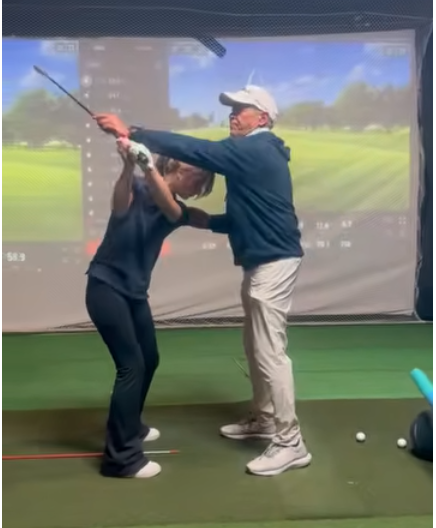
PGA Coach Michael Camastro working with a junior golfer on swing mechanics & TrackMan ball-flight analysis at Players Elite Golf Academy.
If your junior golfer has been taking lessons for a year or two, you have probably asked a version of the same question: is this actually going somewhere? For families comparing a high-performance golf academy against standard junior lessons, the honest answer is that these are two different products with two different goals. One delivers instruction. The other builds a player.
Understanding that distinction before you spend another season on lessons is the single most useful thing you can do for your child's game.
What Standard Junior Lessons Actually Deliver
Standard junior lessons are built around the session. You book an hour, a coach works with your child on a specific skill, and everyone leaves with something to think about. For a young beginner who is still deciding whether they enjoy golf, that model works fine. It is low-commitment, affordable, and flexible.
With traditional individual lessons, improvement often depends on how consistently a golfer practices between appointments. A structured player development program adds supervised practice, ongoing feedback, and an individualized training plan to help players make measurable progress.
Individual golf lessons can be extremely valuable for improving specific skills, and many instructors provide excellent long-term coaching.
For junior golfers preparing for competitive golf, a comprehensive player development program offers additional opportunities for improvement. It combines individual instruction with supervised practice, regular performance assessments, tournament preparation, and an organized development plan.
At Players Elite Golf Academy, our approach ensures that each training session builds upon previous progress. Players receive ongoing feedback, structured practice opportunities, and coaching designed around their individual goals.
That is not a knock on the coaching. It is simply what the format can support.
What a High-Performance Golf Academy Includes
A true high-performance golf academy is organized around the player, not the appointment. The unit of progress is the season or the year, not the hour.
Here is what that structure actually contains at a program like Players Elite Golf Academy:
13An Individualized Development Plan
Every golfer starts with an evaluation, and the plan that follows is written for that specific player. Strengths, weaknesses, physical maturity, competitive goals, and schedule all shape what the training looks like. Two juniors in the same program are not working on the same thing at the same time.
14Supervised Practice, Not Just Instruction
Instruction tells a player what to do. Supervised practice is where the change actually takes hold. In a high-performance setting, a coach watches the reps, corrects drift in real time, and makes sure practice time is spent on the right things. This is the piece most lesson-only families are missing, and it is usually the reason progress stalls.
15Swing and Ball-Flight Analysis
Technology turns coaching from opinion into evidence. TrackMan swing and ball-flight analysis gives juniors and their parents objective data: club path, face angle, attack angle, smash factor, and dispersion patterns. A player who can see the numbers understands why a change matters, and parents can see measurable movement instead of taking progress on faith.
16Tournament Preparation and Course Management
Playing well in competition is a separate skill from hitting good shots. A structured academy prepares juniors for it directly: scoring strategy, target selection, managing nerves, handling a bad hole, and building a pre-shot routine that holds up under pressure. Standard lessons rarely address any of this because they are not built to produce tournament players.
17Accountability and Progress Tracking
Development plans only work if someone is keeping score. In a high-performance program, progress is documented, reviewed, and adjusted. Juniors understand what they are working toward and why. Families know where their child stands and what the next milestone looks like.
How to Decide Which Path Fits Your Junior Golfer
The right answer depends on where your child is and what you both want from the game.
Standard lessons are probably enough if your junior is brand new to golf, plays casually once in a while, and is still discovering whether the sport sticks. There is no reason to add structure to an interest that may not last.
A structured development program becomes the right next step when your junior plays consistently, wants to make the high school team, has started entering tournaments, or has plateaued despite regular lessons. At that point, the missing ingredient is almost never more instruction. It is a system.
A few questions help clarify the decision:
- Has my junior's handicap or scoring average moved meaningfully in the last 12 months?
- Do we know, specifically, what my child is working on and why?
- Is anyone supervising practice between lessons, or is it unsupervised repetition?
- Does my junior understand how to play a course and manage a score, or only how to swing?
If several of those answers are "no," the format is the constraint, not the effort.
Why Structure Produces Results
Skill in golf is built through purposeful repetition, feedback, and progression, not through occasional exposure. A high-performance golf academy is simply the environment that makes all three happen on a consistent schedule, with a coach who is accountable for the outcome.
At Players Elite Golf Academy in Willowbrook, Illinois, that environment is led by Michael Camastro, the 2023 Illinois PGA Teacher & Coach of the Year, with more than 35 years of coaching experience. Program formats range from junior development levels starting at age six to the Players Elite Competitive Golf Team, which pairs weekly supervised small-group practice with individual coaching sessions, TrackMan analysis, short-game and putting training, speed work, and tournament preparation.
The point is not that structure is more expensive or more serious for its own sake. It is that progress you can measure requires a plan you can follow.
The Next Step
Choosing the right golf training program depends on your junior golfer's experience, competitive goals, and commitment to improvement.
At Players Elite Golf Academy, we provide structured player development through individualized coaching, supervised practice, advanced technology, and tournament preparation.
Led by Michael Camastro, 2023 Illinois PGA Teacher & Coach of the Year, our Competitive Golf Team helps serious junior and high school golfers prepare for higher levels of competition.
Our indoor training facility in Willowbrook serves families throughout Burr Ridge, Oak Brook, and the surrounding Chicago suburbs.
Call or text Michael Camastro at 708-259-3766 to discuss your junior golfer's experience, goals, and training opportunities.
Following your conversation, Michael can personally arrange a 45-minute Player Evaluation to determine the appropriate training program.
Whether that answer turns out to be "keep taking lessons" or "it is time for an academy," you will be deciding with real information instead of a guess. For families in Willowbrook, Burr Ridge, Oak Brook, and the surrounding Chicago western suburbs, that conversation starts with a single evaluation.
Interested in the Players Elite Competitive Golf Team?
Call, text, or email Michael Camastro to discuss your junior golfer's experience, goals, and training opportunities.
Online evaluation scheduling is also available.
Schedule a Player Evaluation